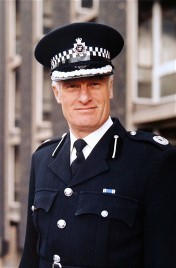
Victim of Crime - Thomas Prall
G-g-g-g-uncle Thomas Prall was born in Crediton in 1791, but by
1816 he was a shopman for linen draper Thomas Lay at 36, Tottenham Court Road,
Middlesex. He was living at the shop, as was his employer. In the early
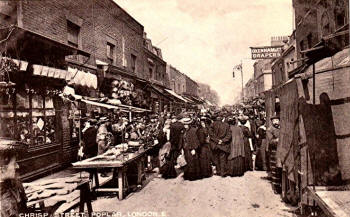
C19th Tottenham Court Road and the nearby St Giles "Rookery" were rough,
impoverished and densely populated areas, with high levels of crime,
driven by poverty and alcohol, but also by organised crime as described by
Dickens in Oliver Twist. The majority of crimes reported in the area were theft-related, including
stealing from shops or houses. Commonplace petty theft included stealing clothes (shirts, stockings) or food, often committed due to severe economic need. Research into Old Bailey records indicate that approximately 2% of all crimes recorded in London in the early C19th had some connection to the Tottenham Court area.
Thomas was soon to encounter the criminals who were to so often disrupt
the business of the shop. The staff were obliged to testify at the
trials of the shoplifters who were captured stealing from the draper's
shop 36 Tottenham Court Road. At first Thomas Prall himself would take the
stand, in his capacity as shopman for Thomas Lay, but after a few years he became the owner of the business and it
was his shopmen who would appear in court to describe the crimes they
witnessed.
Thomas witnessed a theft from the shop on the evening
of 20 January 1816. He gave evidence on 14 February 1816.
"I live at No. 36, Tottenham Court Road . I am employed by Mr. Lay. He is
a linen-draper, residing in Tottenham Court Road. On the 20th January, in
the evening, I was informed that a piece of flannel was taken from the
door. I pursued the prisoner, and found him in a bye street a short
distance from our house. It must be at least a hundred yards to where I
found him from our house. I went up to him, and seized him and
collared him. He had the piece of flannel under his arm. I brought him
back, and when I took him into the shop, I examined the flannel and knew
it to be my employer's property. I knew it by my own marks upon it.
(Property produced.) That is it. It cost 27s. and I have no doubt that it
is my master's. Robert Harris, 26, was indicted for stealing, on the 20th January , three
yards of flannel, value 27s. the property of Thomas Lay . He was found
guilty and confined for 3 months and fined 1s.
Thomas gave evidence at the Old Bailey on 1 Dec 1819. "I am
shopman to Thomas Lay , who is a linen-draper , and lives in Tottenham
Court-road . On the 30th of November, about seven o'clock in the evening,
a stranger called, and asked me if I had lost any goods from the door? On
looking I missed a piece of canvas from inside the door. He said a boy had
been stopped with it in Crown-street - I found them at Coley's house. Thomas Evans,13, was indicted for stealing 72 yards of
canvas, value £1.16s. , the goods of Thomas Lay. He was found guilty and confined
for 3 months.
On 13 January 1825, Edward Wickins gave evidence at the Old Bailey. "I am shopman to Mr. Thomas Prall of Tottenham Court Road. On the 10th of January I saw the prisoner come to the door and take a piece of stuff, which could be reached from the street, by putting one foot into the shop. I followed him down Percy-street - he dropped it, and I picked it up - I did not lose sight of him before I overtook him.
William George Heritage, 21, was indicted for stealing twenty-eight yards
of stuff, value 30 s. the goods of Thomas Prall . Found guilty, he was
confined for 6 months.
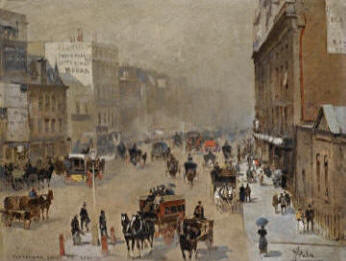
Tottenham Court Road
Charles Gurr took the witness stand at the Old Bailey on 5 January 1832.
"I am shopman to Thomas Prall, linen-draper , of Tottenham Court-road . On
the afternoon of the 5th of December I saw Walker and Tilley in the shop -
they asked to look at some bonnet ribbons, which the apprentice showed
them; I had some suspicion, but they bought a yard of ribbon and a roll of
cotton: when they were gone I looked over the ribbons in the drawer which
had been shown them - I missed some, and went after them: I found them
further on in the road, in company with Watts and another person - they
had joined them about twenty houses from my employer's, on the other side
of the way; I followed them up the road, called an officer and gave them
in charge - these two pieces of ribbon were found on Watts - they are my
employer's - there are thirty yards.
P.C.Charles Mumford " I am a Police-constable. I was at the corner of
Charlotte-street, Fitzroy-square, on the 5th of December, between three
and four o'clock - I took the prisoners and another person; I found the
two pieces of ribbon in Watts's bosom - they were then a hundred and fifty
yards from the prosecutor's shop, and out of sight of it - I heard Walker
say at the station-house, "I took them."
Mary Ann Walker, 15, and Charlotte Tilley, 12, were indicted for stealing
30 yards of ribbon, value 20s., the goods of Thomas Prall ; and
that the
said Charlotte Tilley had been before convicted for felony ; and Mary Ann
Watts
was indicted for feloniously receiving the same, well knowing them
to have been stolen .
In her defence Walker claimed, " I went in to buy a yard of ribbon, but I
took nothing out of the shop." Watts put in a written Defence, stating
that the other prisoners had given her the ribbon, but she did not know it
was stolen.
Walker and Tilley were both found guilty and transported for 7 years. Watts was found not guilty.
Then in March 1832 Charles Gurr was again in the witness box. "I am shopman to Mr. Thomas Prall, a linen-draper , in Tottenham-court-road . On the morning of the 30th of March, the prisoner came to the shop, with another young woman; I served them with three-quarters of a yard of ribbon; I then saw the prisoner put her hand to her bosom - I missed a roll of ribbon; I had counted the rolls before I showed them to them; I followed them out of the shop; they turned a street, and began to run; I called them back, and the prisoner produced this roll of ribbon, and a remnant; there were twelve yards of ribbon, worth 5s.; I gave them both in charge, but the other was discharged.
Emma Maria Smith, 17, was indicted for stealing, on the 30th of March , 12 yards of ribbon, value 5s. , the goods of Thomas Prall .
In her defence Smith declared, "You did not see me put it into my bosom." Charles Gurr. "I saw your hand in your bosom as I came from the window."
Smith. "The other girl took it, and put it into my bosom, under my shawl - I walked round the corner; I gave the ribbon out of my hand to the witness."
Defence witness, "I went last night to her mistress, who keeps a respectable public-house; she is not able to attend, but stated that the prisoner had lived with her three times, and she will take her again."
Verdict: guilty, but recommended to mercy. Confined 14 days.
On 13 June 1842, Thomas Prall appeared in the Old Bailey in person once
again. "I am a linen draper, in Tottenham Court Road. On the 18th of May the prisoner came to my shop. After she left, I had a communication with my apprentice. I went out, and saw the prisoner at the corner of Steven Street, with another woman. I requested her to come back, as she had made a mistake. She came back. I said there was some lace missing. She denied that she had any. The boy said he saw her take it, and put it under her arm. She and her friend were very abusive to the boy. She persisted so much in her innocence, that I was induced, from the possibility of charging her wrongfully, to let her go. They went on to Bedford Square. I sent a policeman after them. He returned with them, and immediately after, the beadle came, and said, "There are eight cards of lace thrown down an area in Bedford Square," and another policeman brought in the lace, which I know is mine. It has my private mark on it. The prisoner went near the place where the lace was found."
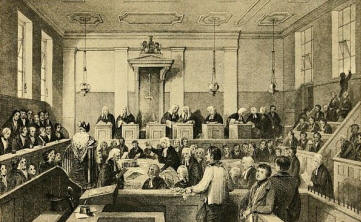
Old Bailey court in session
Richard Buckett , "I am apprentice to Mr. Prall. The prisoner came into the shop. She asked for quilling-net. I showed her some. She bought two yards, at 3/4 d. a yard. She afterwards wanted to look at some thread lace, and said, "Let it be
good". She bought two yards at 4d., and two at 6d. I measured them, and as I was rolling them round my hand, I saw her shawl partly on the counter, with her hand underneath it, drawing from the box some lace. I can swear to four of these cards of lace being in the box which I showed her."
Jane Thomas,20, was indicted for stealing, on the 18th of May, 36 yards of
lace, value £2. 10s., the goods of Thomas Prall. She was found
guilty and confined for 6 months.
Not all the apparent thefts resulted in guilty verdicts. Sarah Kirby was indicted for stealing, on the 6th of February,1841, 9 yards of printed cotton, value 14s., the goods of Thomas Prall.
Henry Collier, and Charles Henry Parker, both shopmen, gave evidence against
her. They claimed that they had seen her hiding a dress under her
cloak, which she dropped on the floor when challenged. She claimed
to have paid with a sovereign for a dress which cost 15s. 11 1/2d. and she
was waiting for her change and for her dress to be wrapped up. There was
evidently confusion as to where her purchase and a similar looking dress
were. A Mrs. Prall got involved, and told her to go. Kirby refused to go
without her dress, which cost her 15s. It is likely that she was trying to
conceal a second dress under cloak, but dropped that on the floor when she
was seen handling it.
She was found not guilty.
1 February, 1841. Mary Connor was indicted for stealing, on the 7th of January, 13 shawls, value
£2.0.0, the goods of Thomas Prall. Shopman Alfred Collier was the witness. "I am in the employ of Thomas Prall, a linen draper, in Tottenham Court Road. On the evening of the 7th of January I observed the prisoner in the shop. She appeared to be in company with another woman. She was asked if she wanted any thing — she nodded. I observed some shawls moved from a pile. I had no suspicion then, but two or three minutes after, I saw her going out, and these shawls fell from under her
shawl. I ran round the counter and picked them up, and then she stooped down to pick them up herself. I took hold of her, and asked what she did with those shawls. She muttered something about her husband and children, and appeared intoxicated, and I let her go. The shawls were moved three or four yards from where they had been. I do not see how they could have got under her shawl accidentally."
P.C. Etheridge had been observing the prisoner. "After she came out I went in; they told me about this, but refused to give her into custody. She was drunk." Evidently they took pity on the woman, who had not actually taken any goods out of the shop. She was found not guilty.
Thomas married in 1845 and probably retired at about the same time. In 1851
he was a retired linen draper, living with his wife Frances, in
Bermondsey.
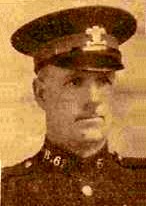
Detective Inspector George McClements
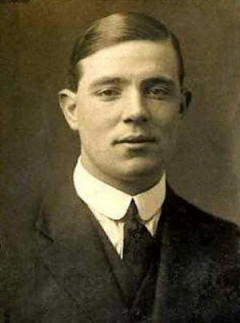
George Arthur McClements
George Arthur McClements, although a Northerner, born in Barnsley in
1894, he did not settle there. By 1911 he was in Devon, working as a
Boots in a Teignmouth boarding house. Three years later on 23 November
1914, he joined the Metropolitan Police (Warrant No 104440) as a Police
Constable. By then the First World War had started. He enlisted in the
London Scottish Regiment on 2 March 1916, as a reservist, and was
called up for service on 12 January 1917. On 30 May 1917 he was
transferred to 2/5 Suffolk Regiment, and embarked for France the next
day. After more than seven months with the Suffolks in France, he was
transferred to the Yorks and Lancs Regiment, on 16 January 1918 and
posted to the 13th battalion, as part of the rebuilding of the battalion
after it had suffered heavy losses. The Yorks and Lancs saw much action
in 1918, and George received a gunshot wound to his neck on 21 May 1918
. He was treated in a field hospital, and was fit enough to return to
the battalion on 17 August 1918. He must have been glad to go home on
furlough from 9 to 22 November 1918, where he could celebrate the
Armistice, but he returned to France. He was finally posted back to
England on 29 January 1919, to Shorncliffe Army Camp near Cheriton, in
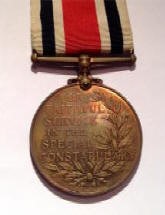
Kent. . He was demobbed on 27 February 1919. He had been promoted to
Lance Corporal, and awarded the silver war badge for his wound, and
received the campaign medals, the Victory Medal and the British War
Medal. He returned to his service with the Metropolitan Police.
By 1920 he was in the CID - a Detective Constable. He was stationed at
Rochester Row, Westminster. In 1921 he was living in the Section House at
Rochester Row. One of 28 constables under a resident sergeant.
While serving in Westminster after the War,
it is likely that he met Sandford lass Amy Hatten, who in 1921 was in
service, as a 25-year-old cook, for Irish widow, Helen Liddell and her
daughter, at 1 Chester Square, SW1.
For George and Amy romance
blossomed, and they were married in Sandford, in April, 1922.
George was a member of the Metropolitan
Police Athletic Club, and represented the Police in regular swimming
races, and other athletic events. He was reported to have been in the
winning Inter-Divisional Tug-Of-War Team in 1924, and in 1923, 1924 and
1925 he performed well in a number of swimming competitions.
As a detective constable George
was less often engaged in arresting criminals in his early years as a
detective than investigating the crimes committed by those who had been
arrested, and then giving evidence at their court appearances.
As a Detective Constable he was a witness at
trials covering all kinds of crimes: assault, theft, drunk and
disorderly, breaking and entering, going equipped, stealing and
receiving, burglary, larceny, stealing by means of a trick,
obtaining money by false pretences, bigamy, loitering with intent,
indecently assaulting children, forgery, fraudulent conversion,
malicious damage, attempted fraud, manslaughter.
George encountered a more unusual crime in July 1920, when he
saw a young man in Artillery Row, Westminster, wearing a ribbon
resembling the V.C. He stopped him and asked him what the ribbon was.
"Don't you know!" replied the young man named McFarland. "It is the
Victoria Cross. I won it”. George asked to see his papers, but when he
said he had lost them, and could only produce an altered identification
certificate in the name of William McFarland, V.C. , George detained
him. At the police station McFarland showed him an invitation to a
garden party at Buckingham Palace. He then claimed the V.C. had been won
by his dead brother. He was remanded while further enquiries were made,
particularly in regard to the Buckingham Palace invitation. These
revealed that he had been in prison for drunkenness at the time of the
Buckingham Palace garden party. He was imprisoned for 6 months with hard
labour for falsely representing that he was entitled to the VC, and for
being in possession of fraudulent soldier’s identity papers.
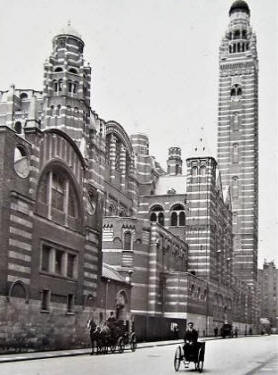
Westminster Cathedral
The Roman Catholic Westminster Cathedral was a common location for
criminal activities it appears, and fell within George’s territory in
his early years. In March 1922, Frederick White, 47, of a common
lodging house, after his guilty plea to robbing offertory boxes in the
Cathedral, was committed to the City of London sessions. George
McClements, giving the prisoner’s history, said he was a persistent
church thief, and when apprehended he had on him many small keys, loops
of copper wire, a spanner and a bent screwdriver. There was also in his
pocket a list of no fewer than fifteen churches, all of which, George
found on inquiry, had at some recent time had their offertory boxes
opened and robbed. The magistrate said he would not deal with such an
experienced thief, for the sentence he could impose was inadequate so he
was sent to the Quarter Sessions. In September 1923, Italian waiter
Alexander Rossi was charged with being in the Cathedral for an unlawful
purpose. He was interviewed by McClements. He was found to have hidden
pieces of whalebone, and a sticky substance, possibly birdlime, in his
hat. The whalebone was use to extract money from collection boxes, and
coins with the sticky substance on them were found in his pocket. He
was fined £20 or six weeks hard labour. In June 1924, Robert Galbraith,
22, of no fixed abode, was charged with being in the Cathedral for an
unlawful purpose. Found crawling up the stairs to the sacristy, when
asked to stop, he bolted. McClements said that a purse was found
on him, that had undoubtedly been stolen from the sacristy. He was
released on probation. On another occasion in February 1925, George
gave evidence regarding George Fennymore,18, motor driver of
Pimlico, charged with stealing and receiving from Westminster Cathedral
a handbag containing 15s 6d. In October 1925 George charged Joseph
Glenville with being in the Cathedral for an unlawful purpose. He was
seen tampering with a damaged offertory box in St Joseph’s Chapel there.
He was sentenced to 10 weeks hard labour. And again in November 1925
George gave evidence against Jane Robertson, 57, of a Church Army
Shelter, for stealing a muff from the confessional box in Westminster
Cathedral. She had a previous conviction for larceny as a servant.
As would be the case today, the criminals dealt with by George
McClements were from a variety of backgrounds. Many were certainly
professional criminals, with multiple convictions, and often of no fixed
abode. But he charged or testified against clerks, labourers, stokers, ,
drivers, bakers, soldiers, sailors, dock workers, painters, errand boys,
porters, charwomen, servants of all kinds, male and female, an engineer,
an advertising agent, , a hawker, grocer, a flower seller, a fruiterer,
a liftman, a window cleaner, a housekeeper, and unusually an author and
short story writer.
While testifying regarding Bridget
Flaherty,18, in June 1922, a servant, who stole a dress ring, the
property of another servant, George said that the ring, worth £2 10s,
was recovered, and the accused had given the police every assistance.
She was released on probation. At the Central Criminal Court, in July
1925, Mabel Tribe, 36, a nurse, was bound over on a charge, to which she
had pleaded guilty, of uttering a forged certificate of character, and
she was discharged. Her counsel, Mr. St. John Hutchinson, said he would
like to mention the fact that the detective officer in the case,
Detective-Sergeant George McClements, had given up a great deal of his
time in going to see the defendant’s friends in order to put her in a
position to be defended. When police officers went out of their way to
help prisoners, he thought it should be known that the police were not
quite such wicked people as they were sometimes made out to be.
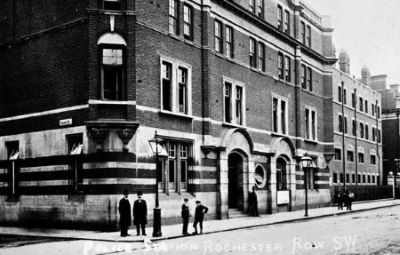
Rochester Row Police Station
In
January 1928 newspapers wrote of the Detective Sergeant who played the
good fairy. One detective had locked up William Warren, aged 48, a
casual porter, on a charge of attempting to swindle him, after he tried
to sell the detective a brass ring as a gold one, and when locked up,
confessed to having paid 9d for the ring that he had guaranteed as 18
carat. When Detective Sergeant McClements went to Warren’s home to make
enquiries, finding the wife and family without food, he provided a meal
for them. Warren was proved at Bow Street Police Court yesterday to have
been convicted 26 times of drunkenness and begging but, in view of his
pleading that his family was destitute, he was given another chance and
merely bound over. In August 1926 McClements investigated a break-in at
a hall in Westminster. He arrested roundsman Edward Lewington,
19, and errand boy John Pink, 18. They were charged with breaking and
entering, with intent to steal tools. George gave evidence that they
were of good character, both in work, and gave their mother the bulk of
their wages. They were bound over for 12 months. As with Bridget
Flaherty, Mabel Tribe, and William Warren, McClements had revealed a
compassionate nature. Throughout his career it was clear that he was
willing to see the good in those he investigated, though he was always
ready to speak out against real villains when his investigations had
revealed them.
By 1927 he had been promoted to Detective
Sergeant. In May 1931 Detective Sergeant McClements encountered a classic “sting”.
Mr. Wilfred Nelson alias William Naughton, , 34, of no fixed
abode , appeared at the Westminster Police Court, charged with another
man not in custody with stealing £180, by a confidence trick, from Mr.
William Caven, a visitor to London from New Zealand. Detective-Sergeant
McClements said that in March Mr. Caven made the acquaintance of the
accused whilst sightseeing. After several meetings, a man walking in
front of them dropped a rosary. When it was picked up and returned to
him, he was very profuse in his thanks, invited Mr. and Mrs. Caven and
the prisoner to a restaurant, and then told a story, supported by a
newspaper cutting, of having just inherited £800,000, of which he had to
distribute a considerable portion among the poor. On learning that Mr.
Caven was a Colonial, the prisoner or his accomplice suggested that he
might help with the distribution. To show that he was a man of substance
Mr. Caven handed over £180, and then the men went away and he heard no
more of them. Nelson was arrested in Dover. When Detective-Sergeant
McClements told him there of the charges that would be preferred against
him, he made no reply. At the Rochester Row Police Station he was picked
out from a number of other men by both Mr. and Mrs. Caven. He was
sentenced to 6 months hard labour.
George was sometimes in the right
place at the right time. Detective-Sergeant McClements and Detective May
were attracted by a man’s suspicious movements in Vincent Square and
kept him under observation. When he was arrested, a jemmy and a black
bag were found on him, the black bag being strapped to his trousers.
Ernest Jones, 62, hawker, of no fixed abode, pleaded not guilty at the
County of London Sessions to possessing housebreaking implements by
night. He was found guilty and he was sentenced to 18 months hard
labour. McClements testified that he had a bad record.
In later years as Detective Sergeant and then Detective Inspector George
McClements was inevitably involved in more serious cases.
By coincidence, George was involved in the
investigation into two infamous “Trunk Murders” - the Charing Cross
Station Trunk Mystery,
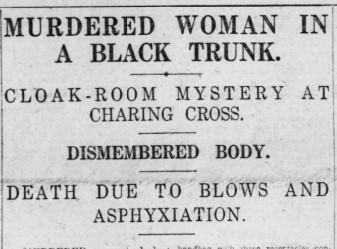
Suitcase body headlines in 1927
when the dismembered body of a woman was
discovered in a trunk at the Left Luggage Office of Charing Cross
Station in 1927 (John Robinson was hanged for the murder of Minnie
Bonati in August 1927.), and then in the investigation in 1934 into the
first Brighton Trunk Murder when the arms and torso of a woman were
found in the Left Luggage Office of Brighton Station, and the legs the
following day in a suitcase in King’s Cross Railway Station. That victim
was not identified and nobody was charged with the murder.
In April 1932 George was involved in the
solving the mystery of a theft from an M.P.’s flat. Alfred William
Martin, 18, of Mason Street, S.E along with Charles Edward Hayes, 25,
appeared in Tower Bridge Police Court, after being apprehended trying to
break into premises in Fendal Street, S.E, occupied by leather-dresser ,
Mr. Gaunt. Detective-Sergeant McClements said that finger prints were
found on Sir Robert Gower M.P.’s sideboard, following a theft at his
flat at Ashley Gardens, S.W., in January, and these were photographed
and recorded at Scotland Yard. When the finger prints of Hayes and
Martin were sent to Scotland Yard on their arrest for attempting to
break into Mr. Gaunt’s place, Martin’s were found to correspond with
those taken at Ashley Gardens. Martin was charged with being found on
enclosed premises, and then further charged with stealing clothing, a
quantity of silverware and three bottles of whisky from the Ashley
Gardens flat, together worth £68. Both the accused men pleaded guilty to
the charges against them. The magistrate sent both men to prison for two
months for the attempted break-in, and Martin to four months in addition
for the Ashley Gardens burglary, to run consecutively.
In October 1937 William John Sullivan, 27, a painter, of Grays Inn Road,
and Joseph Williams, 20, a van guard of Tottenham Court Road, were at
North London Police Court, where they were committed to the Central
Criminal Court on the charge of being concerned together in the
manslaughter of John Sherry, in Holloway on September 18. Together with
Mrs. Mary Sullivan, the mother of Sullivan, they had gone to the house
of Sherry, where he was living with a Mrs. Margaret Murphy. Mrs. .
Sullivan was on bad terms with Mrs. Murphy. An argument ensued, when
Sherry received a blow which caused him to fall from his chair, and
resulted in his death. Sullivan was seen in Tottenham Court Road, and
after a struggle was taken to Tottenham Court Road Police Station.
Detective-Inspector McClements saw Williams in Covent Garden, where he
apprehended him. Williams said “I went to Holloway last night with Bill
Sullivan and I think it was his mother with him. We all went into a
house to see a man and woman there. Mrs. Sullivan had a row with the
woman, shouting and carrying on. I did not want to hear that so I went
to the street door. Just as I got there Sullivan and his mother came out
and we all went away. I don’t know anything about what happened in the
house. Inspector McClements. added that when charged with manslaughter,
neither prisoner made any reply. Under cross-examination it was revealed
that Mrs. Sullivan had six convictions for assault on police, but there
were no charges against Mrs. Sullivan. At the Old Bailey trial in
November, it was claimed that Sullivan struck Sherry when the latter was
about to attack his mother. Joseph Williams was acquitted. Sullivan was
sentenced to prison for nine months for manslaughter. It was later
alleged that Sherry, a Scot, had spent some time in the USA as Al
Capone’s bodyguard.
In April 1939 George investigated the sad events surrounding the death
of Leah Johnson, 31, and her baby. She suffered from a condition of the
pituitary gland which may have affected her mood. Her husband, Matthew
Johnson, had been alerted by the screams of his seven-year-old daughter
and discovered his wife and baby dead in their empty bath. His daughter
said that she had let the water out and had been trying to wake “mammy”.
Detective-Inspector McClements said that the seven-year-old daughter
had stated that while her mother was giving her a bath, the mother put
her clothes over her face and pushed her towards the geyser. The
Coroner: Did you understand it was some sort of attempt on the child? –
I thought so. A verdict was returned that the mother took her life
while of unsound mind and murdered the baby.
In May 1939, Henry Robert Wing ,27, a fruiterer of Holloway, Benjamin
Ling ,33, a motor driver of Finsbury Park, and Leonard Barker ,29, a
painter of Hornsey Rise, were charged with having been concerned with
Charles Culverwell, 27, of no fixed abode, in robbing Maurice Brown ,
hairdresser and tobacconist of Whitechapel Rd., allegedly at gunpoint,
of £121 10s, at Plender Street, Camden Town. They were remanded in
custody.
Detective-Inspector McClements said that he saw Wing at Holloway Police
Station and told him that he resembled the description of one of the men
concerned in robbing Brown by pointing a revolver at him. He replied, “I
am innocent.” Barker was seen later and made a similar reply.. Ling, who
was seen at his address, said: “I don’t know what you are talking
about.” At an identification parade Ling, Wing and Barker were
picked out by two witnesses as having been concerned in the robbery.
Culverwell was later arrested. Wing and Ling were both sentenced to
twelve months imprisonment, Barker to ten months, and Culverwell to nine
months.
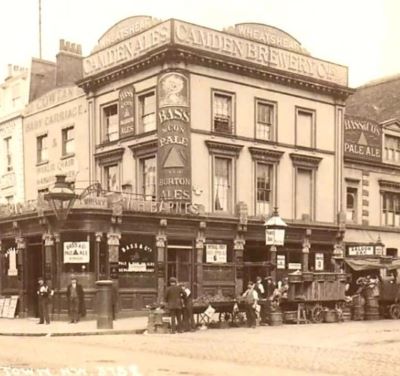
Wheatsheaf pub, Camden High Street,
George’s last posting was to N Division (Islington) as Detective
Inspector. Towards the end of his career he investigated a particularly
violent incident in Camden Town in January 1941. In March, Hampstead
man, William Spriggs, 30, a machinist of Fleet Road , Hampstead, was
committed for trial, charged with having been concerned with others not
in custody, in unlawfully and maliciously inflicting grievous bodily
harm upon Signalman Bools of the Royal Corps of Signals, by striking him
on the face with their fists, and having been concerned with others not
in custody in maliciously wounding Guardsman Robson, of the Coldstream
Guards, by cutting him about the face, head and hands with razors,
broken bottles and broken beer glasses with intent to cause grievous
bodily harm. The charges concerned violent assaults on the servicemen by
a gang of thugs at the Wheatsheaf Public House. The gang, including
Spriggs, entered and sought to provoke the two Signallers in the pub by
throwing their drinks on the fire. Signalman Eric Bools was set upon by
the men, of whom the prisoner was one. He had two teeth loosened, which
were removed in hospital, a black eye and blows on the side of the head
Spriggs hit him about the head with his fist. Guardsman Robson said that
he saw about six men set about the two Signallers. One of the Signallers
was knocked out and one of the men concerned squirted soda-water on to
him from a siphon. He intervened to help them, protesting about six men
setting upon one man. The gang then set upon him. The tallest man, who
had started the trouble, struck the Guardsman with a broken soda-water
siphon. The rest of the men then also attacked him with broken glasses
and razors. He had to have nine stitches on the face, down the right
cheek, for a cut caused by the broken soda-water siphon. He also
received cuts on the nose and on one hand. Detective-Inspector
McClements said that Spriggs was charged after an identification parade
had been held. By the end of April Henry Goldsmith, 20, and the
gang-leader Frederick Andrews, 30, were charged for being
concerned in the wounding, and all were committed for trial at the Old
Bailey.
Detective Inspector George McClements retired
0n 15 June 1942.
After the War George and Amy
lived in Highbury. She died in 1966; he died on 14 July 1979
Shocking Neglect of Children - Stephen Hatten
- "Most Deplorable Case Ever..."
This
chronicles the unfortunate life of stonemason Stephen Hatten of
Sandford - a 3rd cousin, and also connected to our Heard and Wright
and Pickett families by other blood and marital links. Born to a
shoemaker in Sandford he was brought up in the village. By the time he
was 20 he was working as a mason. He married Charlotte Harris in 1875,
and the couple lived in Mill Street, Crediton.
In 1884
he was charged with stealing 11 ½ lb. of lead piping from a
cellar under St. Edmund’s Church, Exeter, near to where he was working. It was
claimed that hew had been storing tools in the cellar, but that the
lead was from cottages that he was pulling down. The charge was not
proved and the case dismissed.
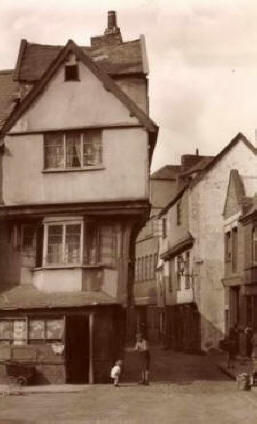
Frog Street, Exeter
16 Mar 1885. At Exeter Police Court, Stephen Hatten, of Frog Lane,
Exeter, was summoned for not sending his daughter Alice regularly to
school. He was fined 2s 6d.
15 April 1885
At the Crediton Police Court, Stephen
Hatten, of Exeter, was charged with being drunk and disorderly the previous night in
East Street, Crediton. He was creating a great disturbance, and was so violent P.C.Kell was obliged to call
on the aid of civilians in order to convey him to the Police Station. He pleaded guilty and was
fined £1 and costs. In default of payment he was sent to prison for one month.
29 Sept 1886. At Crediton Petty Sessions, Stephen Hatten, mason, and
George Ponsford, labourer, pleaded guilty to drunkenness in Mill Street, on Sunday September 26th.
P.C. Fisher said Hatten and Ponsford were drunk and quarrelsome, and
wanted to fight. Ponsford complained that he was pushed down by the
policeman. Previous convictions had been recorded against both
defendants. They were each fined
10s and costs, or seven days' hard labour.
27 Mar 1889. At Crediton Petty Sessions, Stephen Hatten was summoned for not sending his two sons regularly to school. The Clerk to the
School Board said that Hatten had been before the Bench twice previously.
It was an aggravated case, and he asked for the full penalty. Hatten said he sent the children
to school, but they did not go. He was fined 2s in each case.
24 July 1889
At Crediton Police Court, Stephen Hatten, of Crediton, who did not
appear, was summoned for being drunk in East Street on the 9 July. He
was fined 5s and costs, or in default, seven days' hard labour.
2 September 1890
At Bristol Police Court, Stephen and Charlotte Hatten were charged with
cruelly neglecting their children. The prosecution was brought by the Society for the Protection and Prevention of Cruelty to
Children. The officer of the Society, John Oatley, stated that the father of the children was a
bricklayer, and was earning good wages, and the mother received 7s a week from friends
so that there was no reason why they should neglect their children.
Evidence was given to show that both the defendants were addicted to
drinking., and especially the woman. Oatley had visited the room
in Bloomsbury Court where the Hattens were living and had found the children in
a very destitute and filthy state such as to cause
them unnecessary pain and suffering. On a previous occasion he had visited the
room and cautioned the parents. When asked for their defence the
defendants indulged in mutual recriminations, The magistrates considered it a bad case
and believed the woman was rather more to blame than the man. They sent
Charlotte Hatten to gaol for a
month and Stephen Hatten for fourteen days.
31 May 1891 At Exeter Police Court Stephen Hatten, 40, and Charlotte Hatten, 36, were brought up on a warrant charged with
ill-treating and neglecting their child William, aged one year and a half.
The Chief-Constable said the doctor in the case, Mr. Kempe, was currently unable to attend, and
the child was not yet out of danger. He was only therefore going to offer sufficient
evidence that day to justify a remand being granted. Detective Sergeant Vickery said that on
May 18th, he went to a room on the second floor at 21 Lower North Street,
Exeter, occupied by the prisoners. The wife was seated in the room,
drunk, with the infant on her lap. Two other children were lying on a bed in the room with their
clothes on. There was no fire to warm the room. The infant was very ill. Vickery could not get any
sense out of the female prisoner in her drunken condition, and he subsequently left the house. On
the next day he again saw the child, and, because of its appearance, sent for surgeon C.E. Bell. The landlady had also sent for surgeon Mr. Kempe. Both the prisoners were addicted to drink.
On the 21st Detective Vickery saw the male defendant in the tap-room of the Star Inn, drunk. On Sunday
he again visited the Lower North Street house when he saw the husband
and wife. Vickery learned that
the man was earning about 28s a week as a mason at Crediton. When the prisoners were arrested the
woman said her husband starved her, and would not send any money home. When
Detective Vickery interviewed surgeon Mr. Bell about the child, he
learned that the infant was suffering from bronchitis,
caused by neglect and exposure. The Chairman said the case was a very bad one, and the
prisoners would be remanded until Tuesday next. Bail was refused.
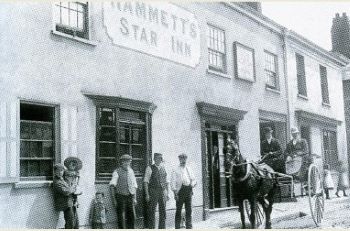
Star Inn, Mill Street, Crediton. Hatten's local pub in
Crediton.
3 June 1891.
The trial resumed . Surgeon Bell, described
how, with Detective Vickery, on
19th May, they found children and mother in an upper room in the Lower North
Street house. The room was very dirty, and
contained little furniture. There was one bed. Charlotte Hatten told him at the
time that five children and herself slept in the room. He considered
that the dirtiness of the room and the emaciated condition of the
children must have been very injurious to health. There were
then three children in the room - Lucy, 6; Albert, 3; and the baby. The children were all very dirty, both in their bodies and clothes. They
were thin and were suffering from want of food. The baby, which the mother said was aged one
year and six months, was dressed, but was in bed was suffering from congestion of the lungs and bronchitis. She said it had
been ill about a week and had had no one to attend it. The conditions under which the children lived were distinctly injurious to
their health. The mother was recovering from the effects of drink. Bell considered the mother was a chronic
drunkard. Dr. Kempe said he called at North Street on 19th May. The poorly nourished condition
of the child, William was one of extreme danger to life. He prescribed for the child, and told the
landlady, Mrs. Stone, to see the treatment was carried out. In his opinion the child would have
died if it had not been very carefully treated, after he had seen it. It weighed 14 ½lbs., and a child
of that age should weigh from 24 to 25lbs. The illness would not account for the emaciated
condition of the child. The mother said the child had been suffering from the measles.
The cause of the child’s illness was neglect and exposure. The landlady said when the child was ill the
mother was frequently drunk. Stephen Hatten used to come home on Saturday nights and go away on Sunday
afternoon. There were “rows”. On occasions Mrs. Stone had to ask them to stop their noise.
On one occasion when they were quarrelling,
Charlotte Hatten was heard to say, “You
ought to bring money home to your starving children.” Witnesses testified how
they had frequently spoken to the mother about the way she neglected her
children, and had often seen her drunk. Sergeant Fursdon of Crediton said he had known the prisoners
there for about ten years, during which time they had continually been brought before the
magistrates for drunkenness and use of profane language. The children always
appeared neglected and dirty. Detective Sergeant Vickery went to
Crediton and told Stephen Hatten of the condition of the child. He was drunk at
the time, but said he would at once go back to Exeter. Vickery had seen two or three
children in Crediton, and these had been well-nourished. One boy stayed with
Stephen Hatten’s
sister, Mary Grant, and the others with Charlotte Hatten’s mother.
Grant said she
maintained the boy Albert, as she had certainly considered him to be neglected by the mother.
Her brother Stephen lodged with her at 7s 6d a week. He was a hard working man. Generally he would come home soon after 10, but occasionally he was -- “well, like other
men.” He would send money to the mother sometimes twice a day—the son came to fetch
it—and she had occasionally seen letters containing postal orders or stamps sent to North Street.
When she asked her brother if his wife looked after her children all
right, he replied that he gave her money and she ought to look after
them.
She should think Hatten sent his wife “off and on” an average of 15s per week. Detective-Sergeant
Dymond said he went to the house in Lower North Street and it was in a filthy condition.
Charlotte told him her husband starved her, but admitted that she had 7s a week in her own
right. Out of that, however, she had to pay 3s 6d for the rooms she lived in.
She said her husband never brought home more than 4s a week, and sometimes he would give her only a few pence. She was scarcely ever free
from bruises, for every Saturday when her husband came home he used to
knock her about. Charlotte Morris, Charlotte's mother, at Crediton, said that
Hatten had married her daughter 15 years ago, when she had £50 of her own. Until this money
was squandered he would not do a day’s work. He was nothing better than an idler and a
drunkard. She had often been to their house in North Street when there was “not even a crust of bread
there”. She had often spoken to the
husband about the matter, but he was a heartless scoundrel, and would
take no notice of what was said. Her grandson John,13, came to Crediton twice or sometimes three
times a day and received money—7s 6d a week from her husband William Harris.
John Hatten confirmed that during the last two months he had often walked to Crediton for his mother. His
father let him have the money, which never amounted to more than 2s. One Saturday night his
father brought home 4s and a piece of meat. With part of the money which John brought
home, his mother would buy a pint of beer. The disturbance always arose about money matters.
“Mother would ask him for money and he would hit her.” His grandfather had often provided him
with clothes. There was one bed, and “when father is home we take off one of the mattresses and
sleep on the floor.” Defending the father Mr. Dunn said this was a case when there had been gross neglect on the
mother’s part. The father was legally to blame for not seeing that the money he sent was applied
to the children. He asked that such sentence would be passed on Stephen as would enable
him to continue his work and support his children. He hoped the Bench would use
the power that the Act under which this case would be dealt with gave
them, to take the children away from the charge of the parents and put
them under the care of the two sisters of the male defendant, who were
very respectable persons – Mrs. Maria Grant and Mrs. Catherine
Coombes – who were quite willing to take the children if the husband
would arrange with them for their maintenance.
The Chief Constable said
there were eight convictions against the father and seven against the mother for drunkenness and
disorder. At Bristol in 1890 the father had been sent to prison for 14 days and the mother for a month
on a charge of neglecting their children. The Bench retired, and on returning the Chairman said this was the most deplorable case which it had ever been his misfortune to
hear from that Bench. If there were any other such families he hoped the sentence of three
months’ hard labour, which it had been decided to pass on both defendants, would be a
warning.—In answer to Mr. Dunn, the Chairman said if those relatives, of whom the police
approved, were willing, the maintenance of the children would be transferred to them, otherwise
the children would go to the Workhouse.
27 January 1892. Crediton Police Court. Stephen Hatten, a labourer, was
charged with being drunk in Brown's Court, Mill Street, on 22nd
January. He pleaded Not Guilty, P.C.Clinnock said he saw the defendant
in Browne's Court, very drunk and using most disgusting language.
Hatten denied the offence, and frequently interrupted the witness
P.C.Clinnick when he gave his evidence, and got very excited. He
called him a liar and offered to go out and fight him. In consequence
of his offensive language he had to be cautioned by the Chairman.
Superintendent Roberts said there were several previous convictions
against him. He was fined 5s and costs or seven days.
28 January 1892.
Stephen Hatten and Charlotte, were charged with willfully neglecting their
children between the 15th December and the 16th January, and not providing them with proper
food and clothing. Mr. W.Friend prosecuted on behalf of the National
Society for the Prevention of Cruelty to Children (N.S.P.C.C. ) He said that he should be able to prove that the defendants had
willfully neglected
their children, and would ask the magistrates to send them to the Quarter Sessions, as it was a
very bad case. The defendants had spent three months in Exeter Gaol commencing last June, and
had also been to prison in Bristol for a like offence.
Mr.F.T.Whetham, of Torquay, Inspector of the N.S.P.C.C., said that on 15th January, he
went to the defendants’ house, in Brown’s Court, Mill Street, Crediton. He told Mrs. Hatten that he
was an inspector, and had heard complaints about their conduct to their children. He asked her if
she would let him see them? She said, “Yes, here they are.” He saw their
boy, Stephen, aged nine years and Lucy Ann, the daughter, aged seven
years. He found that they had sufficient
clothing, but it was very dirty. He examined Lucy, more particularly her underclothing, which was
quite black with dirt. The boy’s clothes were also very dirty indeed. He then examined Lucy’s head;
it was covered with sores and vermin. Their clothes also contained vermin. Both children were in
an emaciated condition and he should think that they had been badly nourished.
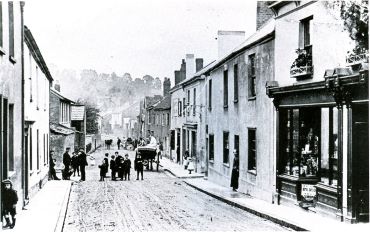
Mill Street, Crediton
He then asked
Mrs. Hatten to let him see where the children slept? She pointed out an old sofa in the kitchen,
and said that she and the children slept on that. The sofa was covered over with sacking, and had a
piece of blanket and a piece of quilt, both very dirty and stinking. Asked how it was that the things were so dirty, she said, “I
cannot wash them for it is all that I have got for the children.” He asked to
see the only bedroom. He found that it contained an old flock bed which was very dirty. The bed
clothes consisted of one piece of blanket, one piece of quilt and two sacks, all of which smelt very
bad. She said her husband slept there. There was nothing else in the room. The atmosphere was of
a very noxious nature. He went to the kitchen and found it also in a filthy state and smelling very
bad. The floor was like a road, covered with dirt and looked as though it had never been washed.
The only furniture there was a table covered with dirt, the sofa already
described, a
broken chair, and a stool. The only crockery that he could find was a broken tureen with tea leaves
in it, and there was a broken tin teapot. On the table was part of a quarter loaf and a few crumbs
of cheese. He found that this was the only food in the house. There
was a small fire burning in the grate. He asked her where her husband was. She said, “Up to the
Star drunk; that is where he always is.” Asked what trade he was, she said “A mason, and a good
workman. He can get good wages, but he will not work.” She added that she had sent for him, and
he had sent her back 3d. He asked her how it was the children were in such a filthy state. She said,
“I am in a great trouble; what can I do?” She was very excited and smelt very strongly of drink. He
fetched a cab and took the children to the Workhouse. Then on 21st January Mr Whetham saw the male
defendant at his house. He asked him how he accounted for his children being in such a filthy
state. He replied “What can I do? I cannot get work and if I cannot get work I cannot get things
for them.”Mr. Whetham asked him how it was that he could always get money for drink?
Hatten replied that the drink was given to him. "If you will give us another chance, we will do better.” Whetham
pointed out, “You have been to prison twice for the same thing, and
one would think
that that was sufficient.” Having made enquiries he had found that Hatten could get plenty of
work if only he would do it. Mr. Scott Campbell, surgeon practising at Crediton, said he visited
the Workhouse on 16th January and saw the Hattens' two children, who were in a very emaciated
condition. There was no disease to account for that. He considered that they had been very much
neglected. Police Sergeant Pratt corroborated the evidence of Inspector Whetham. He often saw
Stephen Hatten going home drunk late at night, and Mrs. Hatten had served 14 days’
imprisonment on December 7th
for being drunk and disorderly. Mr. James Brook, a builder, said Hatten had worked for him
and was a very good workman indeed. He had
offered him work for 24s per week if he would only keep sober. Mrs. Hatten said, in answer to
the Bench, that she had never neglected the children in her life and had kept them as well as she
could with her means. Stephen Hatten said that he had not had any work since the week before
Christmas, as the weather had been against it. His wife had a private income which she spent on
the children as far as it would go. Defendants were both very excited throughout the trial and
Charlotte Hatten begged for mercy with tears. They were committed for trial at the next Quarter
Sessions on the 5th April. They applied for bail which was granted. The Bench
agreed that the children should remain in the Workhouse at least until
the trial was over. [
In 1895 an inspection by the British Medical
Journal was very critical of the standrds at Crediton Workhouse,
particularly the poor care provided there for sick inmates.]
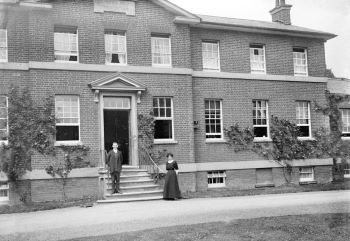
Crediton workhouse
6 April 1892. Devon Easter Quarter Sessions. Stephen (40) and
Charlotte Hatten (30) were charged with child neglect between 15th
December 1891 and 16th January 1892, as heard by Crediton Police Court
on 29 January 1892. , at Crediton, . They pleaded
not guilty. Mr. Wippell prosecuted, and Mr. Cleave
defended. The prosecutor described the facts of the case, as reported
by Inspector Whetham of the N.S.P.C.C., describing his visit to
the house
of the prisoners at Brown’s Court, Crediton, where he found the female
prisoner the worse for liquor.and the two children there greatly neglected. The girl was in a most
disgusting state of filth, covered in vermin, her clothes were
black with dirt. The house, and it was in a
dreadful state, with the woman and the two children sleeping on one bed, which was in a
filthy state. He removed the
children to the Workhouse. PC Clinnock said he had seen the
male prisoner the worse for liquor and the children out late at night.
– Richard Steer, porter at the Crediton Workhouse, and Hanna
Hollingsworth, nurse of the same establishment, said the children were
in a dirty state, and Dr. Walter Campbell said they were greatly
emaciated and seemed to be suffering from a wasting disease, but there
were no traces of any disease, -- John Laskey and J.S.Brooks proved
having offered the male prisoner work, but he had not accepted it. –
Mr. Cleave contended that the willful neglect had not been proved. It
was a case of poverty. – The jury returned a verdict of guilty.—The
Chairman said he was sorry to see two previous convictions recorded
against the prisoners for similar offences. The Court had determined
to make an example of persons who committed such acts of cruelty. The
Act of Parliament under which the proceedings were taken had done some
good, but it would not be productive of good, if on a repetition of
these offences they passed slight sentences. The prisoners would be
kept in prison for six months with hard labour.
29 April 1892
At the Crediton Petty Sessions on Wednesday, Mr. Francis Thynne Whetham, Inspector of the
N.S.P.C.C., applied that the children of Stephen
and Charlotte Hatten, who were brought before the Crediton Magistrates on 27th January,
and were sentenced at the Exeter Quarter Sessions to six months’ imprisonment with hard labour,
might be handed over to the Rev. B. Waugh, director of the Society. He also applied that a sum
should be determined upon for the maintenance of the children. – The Chairman granted the
application, and made an order of 1s 6d a week for each child.
Saturday 8 October 1892,
Exeter Police Court Stephen and Charlotte Hatten, natives of Crediton, were
brought up on a charge of exposing their child, aged about three months. They were found the previous night in the Cowley Bridge
Road in charge of the infant, who was
exposed in such a way as to be endangering its health. When spoken to by a constable they
had refused
to go to the Police Station to spend the night. They were discharged from prison during the day
and were given passes to take them to Crediton, and a sum of money which belonged to them.
P.C. Lewis said that on the previous night about eleven o’clock he saw the prisoners drunk near the entrance
to St David’s Station yard in charge of a child about three months old. The infant’s hands and feet
were uncovered. They said they had missed the 9.30 train to Crediton. They made no attempt to
get lodgings, and said they were going to walk to Crediton. He eventually took them to the Police
Station, where he searched them and found that the man had 1s. 8 ½d. and the woman 6s. 2 ½d.
The Chairman said the Bench would give defendants the benefit of the doubt, and they would be
dismissed, but they must be careful as to their conduct in the future. The Bench commended the
action of the constable.
19 December 1901
Crediton Police Court.
Stephen Hatten, mason, of Crediton, pleaded guilty to being drunk on 14th December. --
P.C.Endacott said he found the defendant lying on the footpath and he had to take him home. -- A
fine of 2s 6d and costs was imposed.
12 July 1902 Charlotte Hatten died at Mill Street, Crediton. Her age
was given as 47, but she was actually 46.
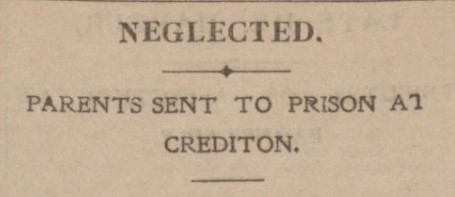
18 December 1902 At Crediton sessions, Stephen Hatten, mason, of Mill Street, was summoned for cruelty
to his three children, Albert, Richard and Henry. Mr. W. Linford Brown, prosecuting, said that defendant was a mason, earning 30s a week. On
25 November, Inspector Thompson, N.S.P.C.C., visited the house
and in consequence of what was then seen, Dr. Campbell was called. He saw the child Albert,
whose face was very pale and pinched, and his body and clothes were exceedingly dirty, while the
boy was very small, was a lot under weight and was suffering from neglect. The condition of Richard was similar. Henry,
aged seven, was in a worse state than either of his brothers. The children's
present condition was injurious to their health. The two smaller boys slept in one
room, while the father and the oldest child slept in another. Both rooms were extremely dirty. The
elder lad was asked when he washed last, and he replied that he had a bathe in the river last
summer. Inspector Thompson confirmed that Hatten had been warned on many occasions as to the state of his home,
by himself, by the police and by the doctor. Mr. W.W. Smith, master of the Workhouse, said the three lads were admitted to the House on
November 25th. One of the boys was three-quarters of a pound less weight now than when
admitted, another was the same weight, whilst the third was three-quarters of a pound heavier.
Hatten said he employed a woman named Elston to look after his children, and paid her 7s 6d
weekly. He earned between 15s and 20s a week. He himself scrubbed the house once a week.
He admitted having been convicted for neglect of children
about eleven years ago, and also for drunkenness.
Mary Ann Elston and Eliza Fey gave evidence in favour of the defendant.
The Bench sentenced the prisoner to three months' imprisonment, with hard labour.
WESTERN TIMES
13
Friday 5 July 1912
Amidst signs of the greatest of sympathy, the mortal remains of Mr. Stephen Hatten were laid to
rest in the Crediton Churchyard on Sunday. Although a native of Sandford, he had long resided at
Crediton, where he was known as a first-class mechanic. The respect for the deceased was
sympathetically shown by his relatives and others who came from far and near to
follow him to his last resting place. He was borne to the grave by the following six bearers from
Crediton: Mr. G.Alford, L. Backwell, W. Forward, L. Risdon, H.Elston, B.Long. The chief mourners
were J. Hatten (son), Mrs. Wellington, (daughter), Albert Hatten (son), L. Hatten (daughter), R.
Hatten (son), H. Hatten (son), Alfred Hatten (nephew), Arthur Hatten (nephew), H.Wellington,
(son-in-law), W.H.Harris (brother-in-law), H. Hatten (son), Ralph Hatten (nephew), Mrs. Hamlyn
(niece),Mr. John Turner Harris (brother-in-law), Mrs. Harris (sister-in-law).

The Devon and Exeter Gazette actually used the Hattens case in an editorial comment on child neglect in those times. " A MORE shocking and, at the same time, deplorable case of child neglect has never been brought before Exeter Magistrates than that in which a stonemason named HATTEN and his wife were charged with neglecting his son WILLIAM, an infant under the age of two years. The evidence disclosed a condition of affairs which it is hardly possible to believe could prevail in these days of enlightenment. Unfortunately for civilisation, these dark spots do exist, and it is only by prompt and energetic action on the part of the authorities that such cases can be unearthed and dealt with in a manner befitting the heinousness of the offence. In the case of the HATTENS their action is the more reprehensible because neither father nor mother seemed to have lacked for means. Money which should have been spent
on clothing and nourishing their children was expended in drink... The medical testimony went to show that the woman was a chronic drunkard, and the poor little victims of their parents’ cruelty were very emaciated and suffering from want of food. But this is not all. Dr. KEMPE found the helpless infant, sixteen months old,
unattended, and suffering acutely from congestion of the lungs and bronchitis.
The child’s life was in “extreme danger”, and when weighed it was
found to turn the scale at some 10 lbs under the normal weight
for an infant of eighteen months - glaring evidence of the neglect and cruel treatment to which the infant had been subjected. The allegation of heartlessness made against the father, applies with equal, if not greater, force against the mother. No woman with a spark of motherly feeling, and with her means, would allow her children to practically starve, and to become so weak as to
put their lives in danger. Consequently there is no palliation for CHARLOTTE HATTEN’S offence. Neither is there excuse for her husband, for it was his duty to see that his children were properly fed and cared for. He did not do so.
Exemplary as is the punishment of three months’ imprisonment passed upon each of the defendants, there will be found no one to say it is too severe or unmerited. It is to be hoped also that the sentence passed upon the HATTENS will act as a salutary warning to other parents of a similar character, for, regrettable as the circumstance is, there are many others like them,
whom have not yet been punished. But what is the moral which adorns this sad tale? It may be summed up in a sentence – the necessity for the establishment in Exeter of a branch of the National Society for the Prevention of Cruelty to Children, to work in conjunction with the police authorities. Commendable and energetic as has been the action of Mr. LE MESURIER and the officers under him in bringing to light so many cases of cruelty to children, there are circumstances surrounding their office which make it difficult for them to get at neglectful parents. These difficulties the Society’s officers have the means of overcoming, and they are therefore, valuable adjuncts in carrying out a philanthropic work in the interests of child-life. We hope that an attempt will be made to resuscitate the movement which was set on foot some months ago with the view of opening a branch in Exeter, and that the effort will be successful.
Devon and Exeter Gazette,4 June 1891
Ernest Rowe - A Catalogue of Petty Crime and Carelessness
A
Pickett great-great uncle, Ernest Rowe (1878-1954) was a mid-Devon farmer,
whose casual contempt for neighbours and regulations saw him facing Courts
throughout his adult life.
In May, 1904 the RSPCA summoned Rowe for working a horse in an unfit state.
The horse was covered in sores, and on the advice of the RSPCA Inspector,
Rowe had shot the horse. The case was dismissed.
On Tuesday, 13 April, 1909, at Tiverton County Police Court, farmer Rowe, of
Cleave Farm, Templeton, was fined 10s for keeping a dog without a license.
On 29 June, 1915 when farming at Templeton, Rowe was fined 7s 6d at Tiverton
Police Court, for failing to bury the carcase of a horse, which had instead
been hidden under faggots of gorse. A police constable giving evidence said
he could smell the dead animal 100 yards away from where it was hidden. Rowe
claimed he hadn't had time to bury it.
On Friday 27 August 1920 at Tiverton County Court, Ernest Rowe of Lugsland
Farm, Cruwys Morchard, was sued for £56 by George Roberts, of Templeton, for
the cost of hay supplied, and the keeping of sheep. Rowe was countersuing
for £6 for "food etc.". Judgment was given for both claim and counterclaim.
On 13 November, 1928, Tiverton Rural District Council successfully made an
application against Rowe for payment of £41 10s for repairs to a dwelling
house at Lower Lapland, owned by Ernest, who was then at Higher Lugsland,
Cruwys Morchard. He was also ordered to pay costs.
On Wednesday, December 3, 1930 at South Molton Police Court Rowe was fined
9s for allowing two horses to stray onto the South Molton- Tiverton main
road.
On Tuesday, 7 July 1931 Rowe was fined 10s with 4s costs for allowing two
horses to stray onto the highway on 4 July.
On Tuesday, 7 March, 1933 Rowe got off with payment of costs only, when
charged with permitting two horses to stray onto the highway. He blamed the
followers of hounds for the horses getting loose.
In June 1933, following an outbreak of swine fever at Cruwys Morchard, Rowe
was fined £2 and 14s 6d costs for failing to keep a record of the movement
of 8 pigs in December of the previous year.
On Tuesday, 5 March, 1935, Rowe was fined 10s 6d at South Molton County
bench for being the owner of 13 sheep found straying on the highway.
On Wednesday, 12 January, 1938, Rowe was fined £2 for failing to report a
cow suffering from TB on 1 December. The animal was obviously emaciated. No
one could have failed to suspect TB. He was also fined 10s for keeping a
bull without a licence.
On 28 March, 1938, Rowe was fined 7s for allowing seven heifers to stray on
to the highway.
On Wednesday 19 April, 1939, Rowe was sued successfully by landowner William
Hunt. Hunt complained that having rented 11 acres of land from him for
grazing his sheep, Rowe had overstayed the agreed rental period by 16 days
and had allowed his sheep to damage the land. Judgment was for Hunt, to the
sum of £3.00 and costs.
On Tuesday, 10 June, 1941, Rowe was fined 15s and his son Ernest 5s at
Tiverton county sessions for causing unnecessary suffering to two sheep
between 1 and 6 May 1941. Two ewes had been cruelly hobbled, one with a
board hanging on her which knocked against her legs and the other with
binder twine that was cutting into her. Both pleaded not guilty, saying they
needed to keep the lead sheep from straying over a hedge.
.jpg)
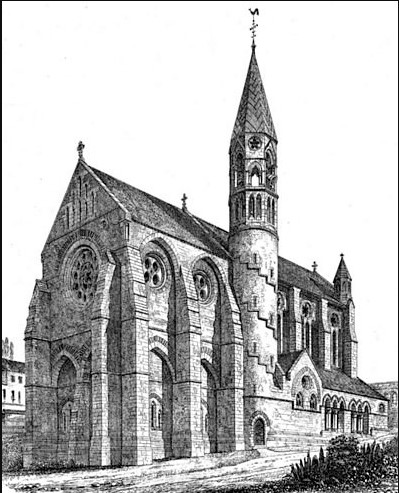 The Crimean Memorial
Church, Constantinople
The Crimean Memorial
Church, Constantinople